

Business Digitals
Empowering Your Digital Future, One Insight at a Time
Beyond Torque Feedback: Integrating Advanced Ground Force Sensing for Next-Generation Robot Stability
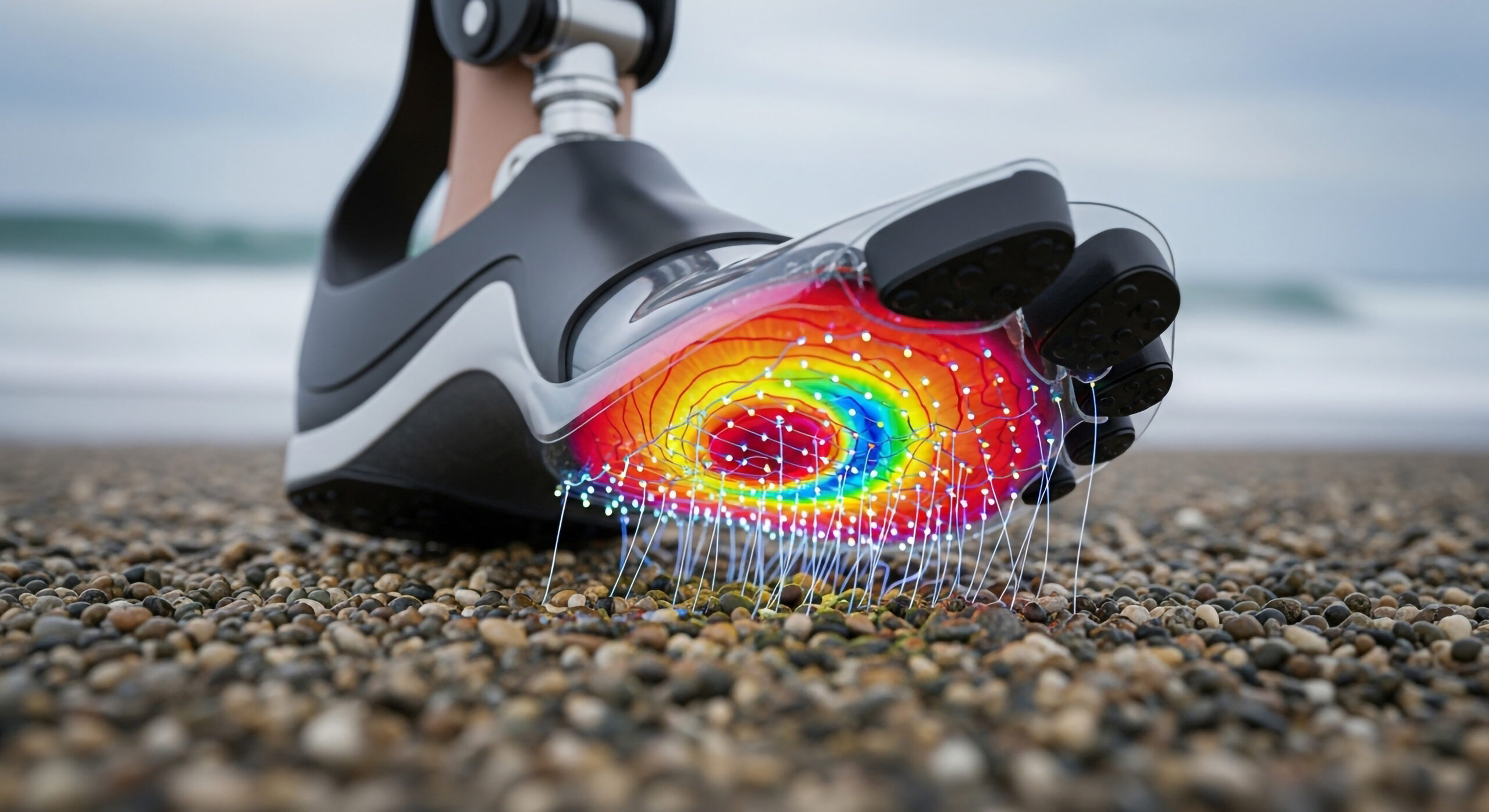
The Robot’s New Sensory Foundation: How Concurrent Sigma-Delta Insoles Enable Human-Like Locomotion
Beyond the limitations of internal joint feedback, advanced foot sensing is providing robots with the critical environmental awareness needed for superior stability, adaptive gait, and the realization of truly natural movement.
The advancement of robotics, particularly in bipedal humanoids (e.g., Tesla Optimus, Unitree), is fundamentally dependent on sophisticated insole foot sensing. This technology is moving beyond simple pressure detection to embrace Concurrent Sigma-Delta (CSD) sensing, transforming the robot’s foot from a basic switch into a continuous, high-fidelity tactile organ.
1. The Foundational Role: Proprioception and Balance
At its core, insole sensing provides robots with proprioception the awareness of the body’s position and contact with the environment. This data is critical for executing dynamic balance algorithms.
- Zero Moment Point (ZMP): To remain stable, a robot must continuously calculate its ZMP, ensuring the Center of Pressure (CoP) remains within the robot’s supporting polygon (the footprint). Advanced force sensors integrated into the foot (acting as “smart insoles”) measure Ground Reaction Forces (GRF) and instantaneous pressure changes.
- Locomotion Control: By analyzing this data, the robot can optimize its gait, correct for unexpected shifts, and prevent falls. This data is also collected from human-worn smart insoles to enable Imitation Learning, teaching robots a more efficient and natural, human-inspired gait.
2. The Technical Leap: Concurrent Sigma-Delta Sensing
Traditional sensor arrays use sequential scanning (time-division multiplexing), reading rows and columns one by one. This process introduces latency, creating “motion blur” in the data when the robot is moving rapidly or slipping.
Concurrent Sigma-Delta (CSD) sensing is the solution, shifting the sensing paradigm from “scanning” to “continuously listening.” CSD systems send unique, frequency-coded signals to every sensor element simultaneously. The system then separates and analyzes the returning signals digitally, providing a complete, zero-latency snapshot of the entire foot.
3. Key Advantages of CSD for New-Generation Robots
Integrating CSD into foot sensing provides a massive upgrade in robot performance, especially in high-speed, dynamic environments:
The Reflex Upgrade (Speed & Latency)
- Zero Latency: CSD’s simultaneous reading provides continuous data flow, eliminating the lag associated with sequential scanning. This is crucial for micro-adjustments in dynamic balancing, allowing the robot’s reflexes to operate faster than human nerve impulses.
- High-Speed Feedback: The instantaneous data allows the ZMP control systems to react to sudden shifts in weight or terrain with unprecedented speed, drastically improving fall prevention and stability on uneven surfaces.
Immunity to Electrical Noise
• High Signal-to-Noise Ratio (SNR): CSD’s modulation technique uses noise shaping to move electrical interference into high frequencies that are easily filtered out.
• Motor Interference: This makes the foot sensors inherently resilient to the massive Electromagnetic Interference (EMI) generated by the powerful, high-torque motors in a robot’s legs, ensuring accurate readings even during sprints or dynamic maneuvers.
Multi-Modal “Super-Touch”
• Data Richness: CSD measures subtle changes in impedance and capacitance alongside pressure. This capability allows the robot to sense the texture, hardness, and dielectric properties of the surface, moving beyond just measuring force.
• Terrain Adaptation: The robot can distinguish between a hard tile floor, a soft rug, or ice, allowing its walking algorithms to intelligently adjust stride length, foot angle, and force application for optimal traction.
Full-Duplex Haptics for Teleoperation
• Sensing and Actuation: CSD enables Full-Duplex functionality, meaning the system can transmit signals (e.g., vibrating a human operator’s insole for haptic feedback) while simultaneously receiving and reading the pressure signal from the ground.
• Teleoperation: This eliminates the “blinding” effect where haptic vibration typically saturates and corrupts the pressure sensor data. A human controlling a robot remotely can “feel” the ground texture through the robot’s foot without compromising the robot’s stability measurements.
Conclusion:
The current methodology for achieving robust robot stability and natural, adaptive movement is often built upon a foundation of fusing internal feedback with inertial data. Specifically, righting algorithms use proprioception, which primarily signals the torque and angle derived directly from joint motors and encoders, combined with external orientation and velocity data from accelerometers and gyroscopes (IMU).
This fusion creates a high-fidelity internal model that determines where the robot is in space and why it is moving, enabling precise control and posture maintenance. However, this methodology’s focus on joint-centric forces, which are forces the robot generates, lacks the critical, nuanced data about the external interaction at the ground surface. It misses subtle changes in texture, small terrain unevenness, or the incipient stages of a slip.
Integrating advanced sensing, like that provided by Concurrent Sigma-Delta (CSD) insoles, directly at the ground force interaction interface is therefore essential. This external, high-resolution foot data provides the missing layer of environmental awareness that the internal joint feedback cannot capture, allowing the righting algorithms to move beyond reactive posture control toward true, proactive stability and natural, human-like locomotion.
About the author : Shawn Gray

Experienced corporate operations professional and visionary distinguished by extensive expertise in technology and business leadership, assuming the role of a dynamic catalyst for change with a remarkable history of achievements in propelling enterprises forward.


